
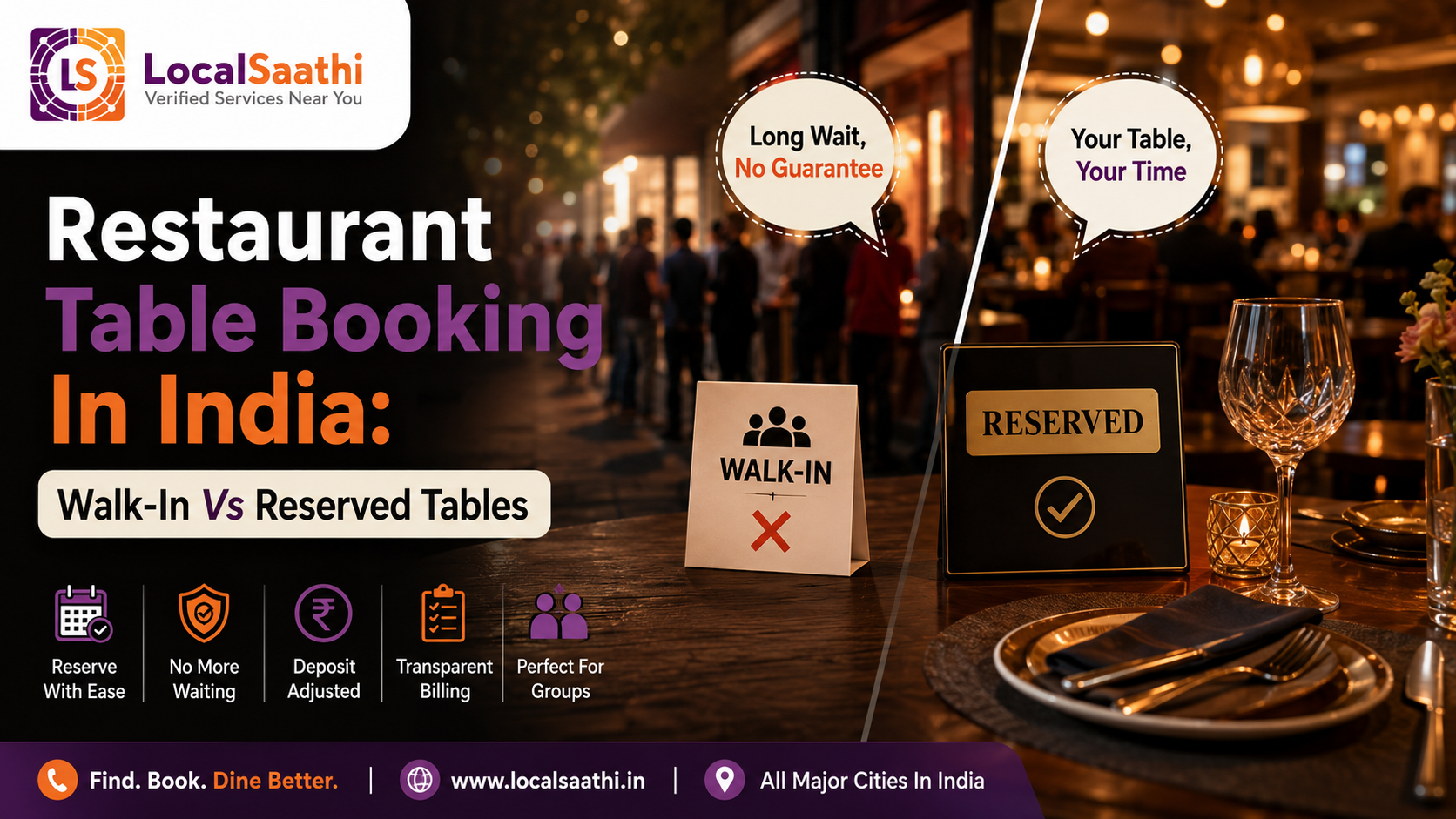
Walking in works fine on a Tuesday. On the Saturday of Diwali week, it costs you ninety minutes on a footpath.
Festival season compresses months of demand into a handful of evenings. Restaurant table booking stops being optional in those weeks, and the rules around holding, deposits and billing become worth knowing before you turn up.
Key takeaways
- ✓Most restaurants hold a reserved table for only 15 to 20 minutes.
- ✓Festival evenings often run two fixed seatings instead of open dining.
- ✓A deposit is usually adjusted against your final bill, not an extra fee.
- ✓Service charge is voluntary in India and cannot be added by default.
- ✓Groups above six need at least a week of notice in peak weeks.
When should you reserve instead of walking in?
Reserve whenever three conditions overlap: a weekend evening, a group larger than four, and a restaurant with fewer than sixty covers. Restaurant table booking earns its effort in exactly those cases, because small dining rooms fill from confirmed lists before the door ever opens.
Walking in still makes sense more often than people assume:
Weekday lunch at almost any format outside a business district.
Solo dining, where a bar seat or counter usually opens within minutes.
Large chain outlets in malls, which hold high cover counts and fast turns.
Cafes and quick service formats, which rarely take reservations at all.
The dividing line is turn time. A cafe turns a table in forty minutes, so a queue moves. A fine dining room holds a table for two hours, so a queue barely moves at all.
There is a middle option most diners skip. Call the outlet twenty minutes before you leave home and ask what the current wait is. Hosts answer that question honestly, because an accurate wait keeps people from arriving and leaving angry.
How does festival season change table availability?
Festival weeks replace open dining with structured seatings. Restaurant table booking during Navratri, Durga Puja, Diwali and the Christmas to New Year stretch often means choosing a fixed slot, a set menu and a per head price rather than arriving whenever you like.
The pattern differs by festival, and knowing which one you are booking around helps:
Navratri. Many kitchens switch to sattvic menus without onion or garlic. Ask before booking if that matters to your table.
Durga Puja. Kolkata dining runs late, with peak demand between 9 pm and midnight during pandal hopping.
Diwali week. Corporate parties block private dining rooms weeks ahead, which shrinks the main floor for walk-ins.
Karva Chauth. A sharp rush lands after moonrise, roughly 8:30 pm to 10 pm, in North Indian cities.
31 December. Most outlets move to prepaid entry with a cover charge, and refuse walk-ins entirely.
National dry days such as 2 October also change plans. Alcohol service stops, and some bar-led venues either close or run a food-only menu, so confirm before you commit a group. It is worth checking the current listing on LocalSaathi's full category directory rather than relying on last year's timings.
Walk-in or reserved: which one wins in each situation?
Neither approach wins outright. The right choice depends on party size, day of week and the format of the venue, and the table below maps the common cases most diners actually face across Indian cities.
| Situation | Better choice | Why it works | Watch out for |
|---|---|---|---|
| Weekday lunch, two people | Walk in | Low demand, fast turns | Business districts at 1 pm |
| Friday or Saturday dinner | Reserve | Confirmed lists fill first | Grace period of 15 minutes |
| Festival evening, six or more | Reserve with deposit | Group tables are limited | Set menus, no a la carte |
| New Year's Eve | Prepaid cover | Walk-ins are refused | Non refundable entry fees |
| Solo diner, any night | Walk in | Bar and counter seats open | Kitchen closing times |
| Birthday with a cake | Reserve, and tell them | Cakeage and seating planned | Outside cake charges |
Read the last column first. Most bad evenings come from the watch-out item rather than from the choice itself, and every one of them can be settled with a single phone call before you leave.
How long will a restaurant hold your reserved table?
Between 15 and 20 minutes at most independent restaurants, and sometimes only 10 on a full festival night. A restaurant table booking is a commitment on both sides, so the seat you did not claim gets released to the queue standing at the door.
Call the outlet if you are running late. A phone call almost always extends the hold, because the host can reshuffle the floor plan when they know you are coming.
Expect a seating limit in return. Peak evenings usually allot 90 to 120 minutes per table, and staff will politely mention it when you sit down rather than when you order dessert.
Should you pay a deposit to confirm a table?
For high demand slots, yes. A deposit attached to a restaurant table booking is almost always adjusted against your final bill, so a genuine diner pays nothing extra. Outlets ask for one because peak weekend no-shows run into double digits.
Ask three questions before you pay anything:
- 1Is the amount adjusted against the bill or charged as a separate fee?
- 2What is the cancellation window, and is the deposit refundable inside it?
- 3Does the deposit lock you into a set menu or a fixed seating time?
Restaurants that publish these terms clearly tend to be the ones that honour them. Many independent outlets now manage availability through their own listings and directories, and our guide on how local businesses get more leads explains why that channel matters to them.
What should you check on the bill before paying?
Check three lines: the GST rate, the service charge, and any cover or cakeage entry you did not agree to. Standalone restaurants in India charge 5 percent GST on food, and service charge is voluntary rather than compulsory.
The legal position on restaurant service charge is settled. Guidelines issued in July 2022 barred hotels and restaurants from adding it automatically, and the Delhi High Court upheld those rules in March 2025, holding that a mandatory levy is an unfair trade practice.
That means you can ask for the amount to be removed, and the restaurant cannot refuse you entry or service for asking. Tipping stays entirely your call, which is the point the court made explicitly.
Cover charges work differently. On 31 December or a ticketed festival night, a cover is a disclosed condition of entry, and it is usually redeemable against food and drink rather than an added tax.
If a line item is disputed, settle it at the table rather than after you leave. Ask the manager for a revised bill, keep the original copy, and pay the corrected amount. A photographed bill is the only evidence that survives the evening.
How do you make a restaurant table booking that gets honoured?
Confirm it twice and put the details in writing. A restaurant table booking taken verbally over a busy phone line is the one most likely to go missing, so a message trail with the outlet gives you something to point at when you arrive.
Work through it in this order:
- 1Book direct with the outlet, not the head office number, for a specific branch.
- 2Give the exact party size, and update it the moment the count changes.
- 3Ask for a written or SMS confirmation with date, time and party size.
- 4Mention birthdays, wheelchair access, high chairs or dietary needs at booking.
- 5Reconfirm on the morning of the reservation during festival weeks.
- 6Arrive within ten minutes of your slot, or call ahead if you cannot.
How far in advance should you book a restaurant table? Two to three days for a normal weekend, seven to ten days for a festival evening, and three to four weeks for 31 December at a popular venue.
Frequently asked questions
Can a restaurant refuse to seat you without a reservation?+
Yes. A restaurant may decline walk-ins when the floor is fully committed, including tables that look empty but are held for guests arriving shortly.
Is a restaurant reservation in India ever legally binding?+
Not as a contract in most cases. A prepaid deposit or a ticketed festival cover creates an obligation, but a free reservation is a mutual courtesy on both sides.
What happens if the restaurant loses your booking?+
Ask for the written confirmation to be checked first. Most outlets will seat you at the next available table or offer a drink while they clear one, though neither is guaranteed.
How early should you arrive for a reserved table?+
Five to ten minutes before the slot. Arriving very early rarely helps, since your table may still be occupied by the previous seating.
Do you have to pay service charge in India?+
No. It is voluntary, cannot be added automatically, and you can ask for it to be removed without losing your table or your service.
Can you make a restaurant table booking for a large group?+
Yes. A restaurant table booking for more than eight guests usually needs a deposit, a set menu or both, plus at least a week of notice during festival weeks.
What should you do next?
Decide now whether your evening is a walk-in night or a booking night, using party size and the day of the week as your test. If it is the second, make the restaurant table booking today rather than on the day.
Confirm in writing, arrive on time, and the table will be waiting when you get there.