
Your connection drops every night at 9 pm, and the big-brand technician is “scheduled” for Thursday. Sound familiar? Before you give up, browse local services by category on LocalSaathi and see who works in your area.
This guide to local wifi companies covers who they are, what they sell, and how to choose one without regret.
The Short Version
- ✓Small operators usually win on support speed and installation time, not on raw price.
- ✓TRAI collected June 2026 broadband data from 1,580 operators, so your street may have options.
- ✓Ask for a trial, written terms, and the all-in monthly price including GST.
- ✓Check upload speed, backup power, and who actually owns the cable.
What Are Local WiFi Companies And How Do They Work?
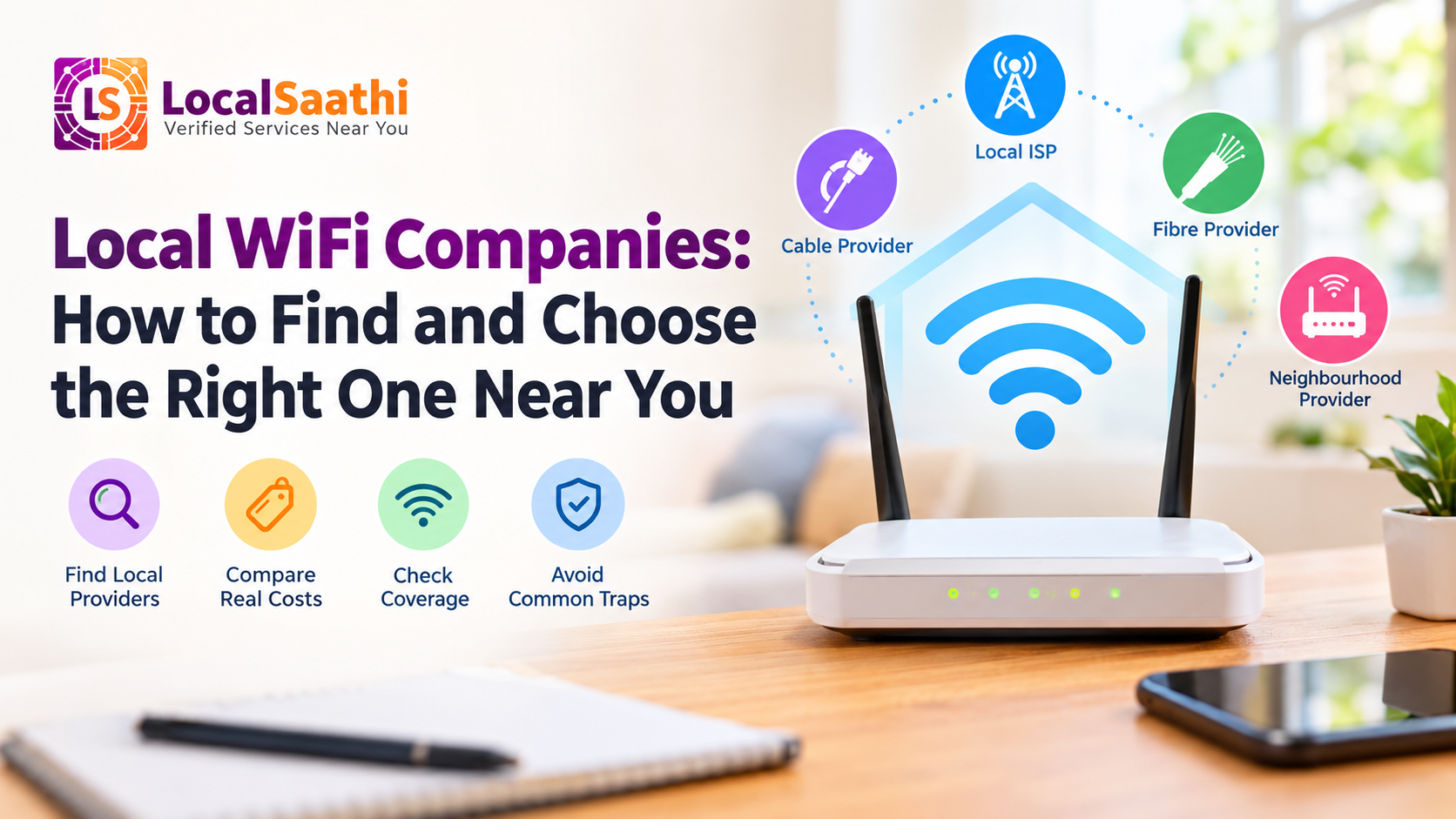
Local wifi companies are small, area-based internet providers that serve a few neighbourhoods or one city. They bring the connection to your door through fibre, cable, or wireless radio, often buying bandwidth from a bigger network, and they answer to a nearby office instead of a distant call centre.
Most of them fall into three groups. Knowing which one you’re dealing with changes the questions you should ask.
Neighbourhood fibre ISPs: They run or lease fibre lines and sell home plans, often to whole apartment societies.
Cable operators with broadband: Your local cable TV operator who added internet on the same network.
Wireless radio providers: A tower beams the signal to a small receiver on your roof, which helps where cables haven’t reached.
I’ve seen the same street served by all three at once, with neighbours arguing over which is best. The honest answer is that it depends on the building and the people running it.
None of these is automatically better. A wireless link can beat a badly maintained cable line, and a tidy fibre network can lose to a cable operator who answers his phone at midnight.
Why Do People Choose Local WiFi Providers Over Big Brands?
Mostly for faster support and flexible terms. A local team can send someone the same day, adjust a plan, and fix a fault without a ticket number. Big brands win on scale and name recognition, so the right pick depends on what irritates you most.
Plenty of people searching for local wifi providers are escaping one specific annoyance, like a three-day wait for a technician or a plan that changed without warning.
Choosing between local wifi companies and a national ISP is really a trade of scale for attention. Here’s what tends to tip the decision:
Same-day or next-day visits for faults
Willingness to negotiate on installation or annual plans
Plans bundled with cable TV or a small business line
A person you can call by name
To see how lopsided the market is, look at TRAI’s June 2026 subscription release. It shows the five largest broadband providers holding 98.59% of subscribers, leaving 1.41% for everyone else.
That share counts mobile data users too, so it overstates the gap for home broadband. Still, 1,580 operators reported to TRAI that month. Smaller names exist, and one may already have a line to your building.
How Do You Find WiFi Companies Near Me Without Guessing?
Start with people, not search engines. Ask neighbours, your apartment association, and nearby shop owners which operator already has a line in your building. Then call two or three of them. Small operators rarely publish street maps, so one phone call tells you more than a website.
Typing wifi providers near me into a map app gives you names, but it won’t tell you who actually covers your lane. Most local wifi companies grow by word of mouth, so a recommendation from the flat next door counts for a lot.
Good people to ask:
Your society’s secretary or facility manager
Tenants in the same building who work from home
The tea stall or kirana owner who streams matches on a phone all evening
Owners of nearby offices and clinics
Paying guest places make a useful test case. One owner picks one operator for dozens of residents and hears every complaint. Browse the PG and hostel listings near you and ask the owner what they run.
What Should You Compare Before You Choose A Provider?
Compare plans on five things: the all-in monthly price, real speed at night, upload speed, fault response time, and how easily you can leave. Headline megabits matter least, because anyone can print a big number on a pamphlet.
Local wifi companies differ most on the boring details, so put them side by side before you pay a rupee.
| Provider type | Usually strong at | Watch out for | Good fit for |
|---|---|---|---|
| Neighbourhood fibre ISP | Steady speeds, quick local visits | Small team, patchy night support | Apartments and gated societies |
| Local cable operator | Bundles with TV, easy payment | Older cabling, shared congestion | Independent houses and older buildings |
| Wireless radio provider | Reaching places cables can’t | Weather and line-of-sight issues | Outskirts and new layouts |
| National brand | Large network, formal processes | Slow visits, rigid plans | People who want a big name |
One more thing to ask: who’s doing the cabling and router setup? If you’d rather hire someone independent, IT and digital services providers can handle the hardware side.
What Does A Local WiFi Connection Really Cost?
Expect to pay for four things: the monthly plan, one-time installation, router hardware, and GST on top. Some operators fold installation into a yearly plan, while others charge it separately, so always ask for a single all-in figure for the first year.
Where people get surprised is rarely the plan price. It’s the extras that show up on the first invoice. Ask about each of these before you agree to anything:
Installation and cable charges: Is there a flat fee, or is it charged per metre of cable?
Router: Is it free, rented monthly, or something you buy outright?
Deposit: How much, and how many days does the refund take?
Plan changes: Can you move to a faster plan mid-year without a penalty?
Write the answers down, or better, ask for them on the plan sheet. A friendly verbal promise is hard to enforce six months later, and good operators don’t mind putting it on paper.
Router placement matters too. A central spot, off the floor and away from the kitchen, usually does more for your signal than a pricier plan.
How Do You Test A Local Wifi Connection Before Committing?
Before you commit to any of the local wifi companies on your shortlist, ask for a trial and run seven quick checks at peak hours. They expose most problems before you’ve signed anything or paid a deposit.
- 1Run a speed test at 9 pm, not at noon. Evening is when neighbourhood networks get crowded.
- 2Check upload speed, not just download. Video calls and cloud backups depend on it.
- 3Hold a 30 minute video call and watch for freezes or robotic audio.
- 4Ping a popular site and note the delay. Steady numbers beat a low average with big spikes.
- 5Ask what happens in a power cut. Both the operator’s equipment and your router need backup, and a small UPS for the router costs little.
- 6Call support once with a made-up question and time how long a human takes to answer.
- 7Read the agreement for lock-in periods, deposit refunds, and installation charges.
Planning cameras you’ll watch from your phone? Upload speed is the number to push on, and a CCTV installation provider can tell you how much bandwidth your setup really needs.
Is A Local WiFi Company Good Enough For A Shop Or Small Office?
Usually yes, if you get a written fault-response time, a GST invoice, and a plan whose fair-use limits you’ve read in full. Shops that run billing software, UPI machines, or cameras should also ask about a static IP and a backup line.
Small operators have real weak spots, and it’s better to know them upfront:
A tiny technical team can mean slow fixes on a festival weekend
Some resell bandwidth, so an upstream outage can take you down with them
Informal paperwork is common, so insist on a signed plan sheet
Growth can strain capacity if the operator adds buildings faster than cable
Picture a small tailoring shop with a billing app, a UPI soundbox, and a phone on a stand for customer calls. Nothing there needs enormous speed, but all of it needs a connection that doesn’t vanish at 7 pm on a Saturday. That reliability is worth more than an extra 100 Mbps.
If you only need a good desk and dependable internet for a few months, a coworking space can be a simpler answer than setting up your own business line.
Frequently Asked Questions
Are local wifi providers cheaper than big brands?+
Not always. Monthly rates are often similar, but local operators may waive installation or reward annual plans, so compare the all-in price with GST, router rental, and setup.
How do I find wifi providers near me?+
Ask neighbours and your society office which operator already has cable in your building. Then phone each shortlisted company to confirm coverage, since small operators rarely publish street-level maps.
What speed do I need from a local wifi company?+
Most local wifi companies sell plans from 50 to 200 Mbps. A family with two streaming screens and work calls is usually fine at 100 Mbps, so trial a plan before paying for more.
Do small wifi companies offer a free trial or refund?+
Some do, though many don’t advertise it. Ask for a trial of three to seven days in writing, along with refund terms for the deposit and installation, before handing over any money.
Is a local ISP reliable enough for work from home?+
Yes, if latency stays steady and faults get fixed quickly. Test video calls at your busiest hours before committing, and keep a mobile hotspot ready as a fallback.
Can a small business use a local wifi company?+
Yes, for most shops and small offices. Ask for a GST invoice, a static IP if you run billing software or cameras, and a written fault-response time.
Where Do You Go From Here?
Shortlist two operators, run the seven checks, and sign only after a trial. Save the runner-up’s number in case the first one disappoints.
And if you run a neighbourhood broadband business yourself, list it free on LocalSaathi so the next person searching for local wifi companies in your area can find you.
List your business free