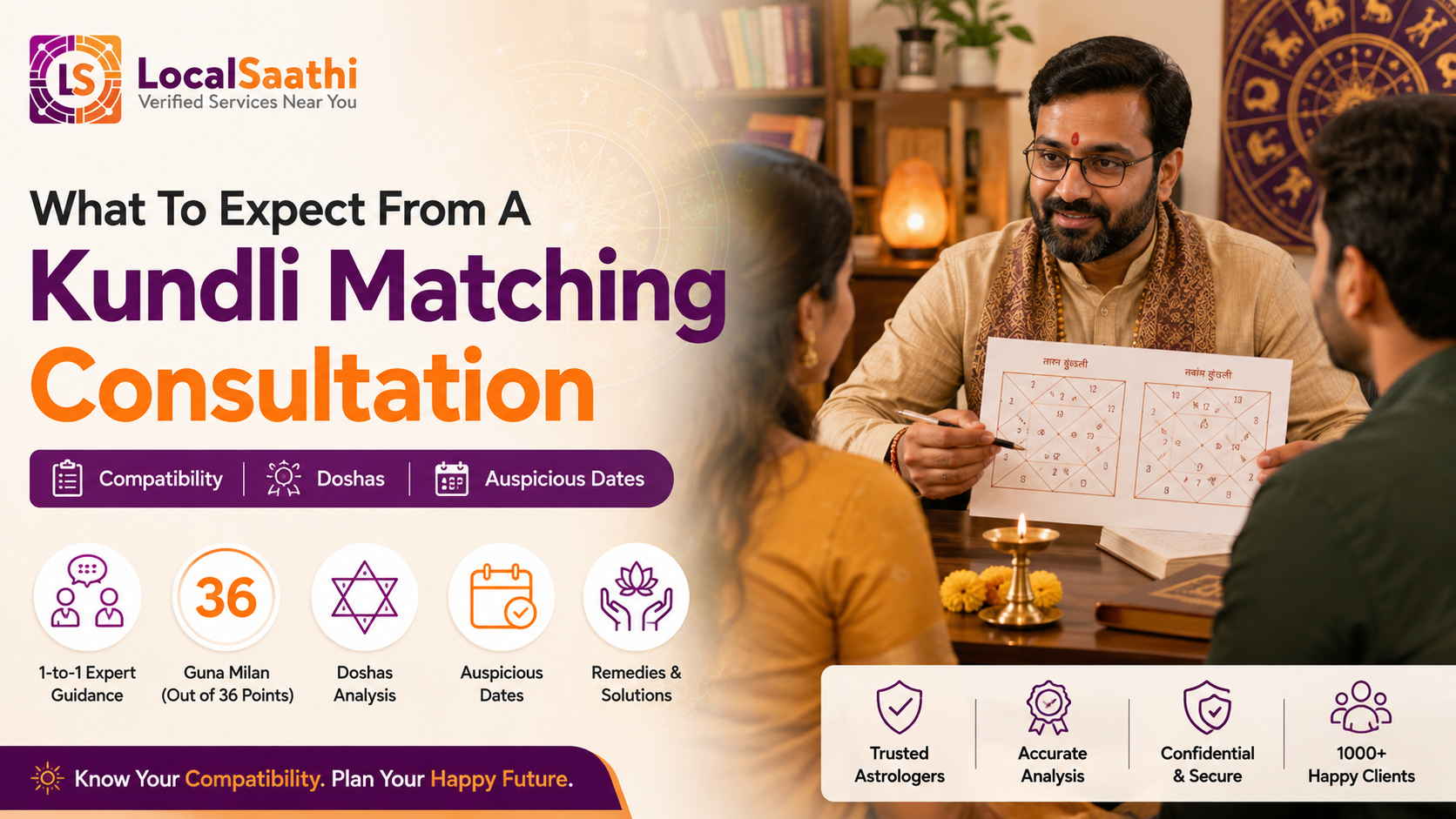
Two families agree on a match, someone suggests getting the horoscopes checked, and suddenly you are sitting across from an astrologer with no idea what is about to happen.
A kundli matching consultation follows a fairly standard sequence, and knowing that sequence changes the experience completely. You stop nodding along and start asking useful questions about the score, the doshas, and the dates being proposed.
Quick Answer
- ✓Sessions run 30 to 60 minutes and cover compatibility, doshas and dates.
- ✓Guna milan scores the two charts out of 36 points across eight categories.
- ✓Doshas matter more than the raw score in most practitioners' reading.
- ✓Exact birth time is the single detail that decides the reading's accuracy.
- ✓Astrological compatibility carries no legal weight in an Indian marriage.
What Happens In A Kundli Matching Consultation?
A kundli matching consultation usually moves through four stages: collecting birth details, generating and checking both charts, running guna milan for a compatibility score, and then discussing doshas, remedies and possible wedding dates. Most of the talking happens in the last stage.
The first two stages are largely mechanical now. Chart generation is software driven, so the value of the session sits in interpretation rather than calculation.
Expect the astrologer to spend the bulk of the time on three things:
Where the score comes from, category by category, rather than just the total.
Which doshas appear in either chart, and how serious they consider them.
What follows next, meaning remedies if suggested, and auspicious dates if the match is being taken forward.
What Details Do You Need To Carry?
Bring the full name, date of birth, exact time of birth and place of birth for both people. Birth time matters most, because the ascendant changes roughly every two hours and the Navamsa chart used in horoscope matching for marriage shifts with it.
| Detail | Why It Matters | Where To Find It |
|---|---|---|
| Date of birth | Sets planetary positions | Birth certificate, school records |
| Time of birth | Fixes the ascendant and Navamsa chart | Hospital record, birth certificate |
| Place of birth | Adjusts for latitude and longitude | Birth certificate |
| Full name at birth | Used in some naming based methods | Family records |
Hospital records are the most reliable source for birth time. Family memory is not, and a difference of even 20 minutes can move the ascendant into the next sign and change the entire reading.
If the birth time is genuinely unknown, say so at the start. Some astrologers offer birth time rectification using known life events. Others will decline the reading rather than guess. Both responses are reasonable.
How Does The 36 Point Guna Milan Score Work?
Guna milan compares the two Moon charts across eight koota categories, each carrying a different weight, adding up to 36 points. A kundli matching consultation almost always opens with this number, so it helps to know what sits behind it.
| Koota | Points | What It Is Read For |
|---|---|---|
| Varna | 1 | Working temperament |
| Vashya | 2 | Mutual influence |
| Tara | 3 | Health and fortune |
| Yoni | 4 | Physical compatibility |
| Graha Maitri | 5 | Mental and emotional fit |
| Gana | 6 | Temperament and disposition |
| Bhakoot | 7 | Household prosperity |
| Nadi | 8 | Health and progeny |
The convention most practitioners follow is that 18 or above is workable, 25 and above is considered good, and above 32 is rare. Below 18 usually triggers a longer conversation rather than an outright refusal.
Ask for the category breakdown, not just the total. A 20 built on strong Graha Maitri reads very differently from a 20 that clears Nadi but fails on temperament.
Two categories carry outsized weight simply because of their point values. Bhakoot at seven points and Nadi at eight together account for 15 of the 36, so a chart pair that fails both can score poorly while matching well on everything else.
Which Doshas Come Up, And How Seriously?
Three come up repeatedly: Mangal dosha, where Mars sits in certain houses, Nadi dosha, where both charts share the same Nadi, and Bhakoot dosha, arising from particular Moon sign combinations. Most astrologers weigh these more heavily than the total score.
Practice varies widely here, and that is worth knowing before the session rather than after. Some treat Nadi dosha as close to disqualifying. Others consider it cancelled under a range of conditions.
If a dosha is flagged, ask three specific questions:
Which houses or signs produce it, so the reasoning is visible.
Whether any cancellation applies, since most doshas have recognised exceptions.
What the remedy involves, in time and cost, before agreeing to anything.
A useful kundli matching consultation leaves you able to explain the finding to someone else in your own words. If you walk out knowing only that something is wrong and that it will cost 40,000 rupees to fix, you were sold a product rather than given a reading.
How Are Wedding Dates Chosen After The Match?
Once a match is accepted, the astrologer moves to muhurat selection: picking auspicious windows using the panchang, which tracks tithi, nakshatra, yoga and karana. Ask for three or four options across different months rather than one fixed date.
A shubh muhurat for marriage is often a narrow window rather than a whole day, sometimes running only 90 minutes. That is the detail that catches families out, because the entire event schedule has to be built backwards from it.
Muhurat work is often billed separately, so confirm at the outset whether your kundli matching consultation includes it. Some practitioners bundle both; others quote the compatibility reading first and charge again for date selection.
Get the dates before you book anything else. Venues, wedding photographers and caterers all fill up months ahead in peak season, and a shortlist of possible dates is far easier to work with than a single one.
What Should You Ask Before Booking?
Treat it like hiring any other professional. Before you pay for a kundli matching consultation, get clarity on the practitioner's system, their fee, the format of the output, and whether follow up questions are included.
- 1Which system do you follow, North Indian, South Indian, or KP?
- 2What is the fee, and does it cover muhurat selection as well?
- 3Do I get a written report, or only a verbal reading?
- 4How do you handle an unknown or uncertain birth time?
- 5Are follow up questions included after the session?
- 6Do you sell remedies, gemstones or pujas yourself?
That last one matters most. An astrologer who charges only for the reading has no financial stake in finding a problem. You can compare astrology consultation providers and read what previous clients said before you commit.
Fees vary a great deal by practitioner and city. A straightforward compatibility reading commonly starts around 1,100 rupees, while a detailed written analysis with muhurat selection runs considerably higher. Agree the number before the session begins rather than after, and ask what happens if you need a second opinion later.
Frequently Asked Questions
How many gunas are required for marriage?+
Eighteen out of 36 is the conventional minimum, with 25 and above treated as a strong match. Most astrologers weigh doshas alongside the score rather than reading the number alone.
How long does a session take?+
Typically 30 to 60 minutes for a first reading. Sessions that also cover muhurat selection and remedies often run longer or are split across two appointments.
Can a kundli matching consultation be done online?+
Yes. An online kundli matching consultation needs only accurate birth details, so video and phone sessions are now common, though a written report is worth requesting.
What if the horoscopes do not match?+
Most astrologers suggest remedies or a re-examination under different methods. Some couples proceed anyway, since the reading carries no legal or binding force.
Is a paid reading better than a free online tool?+
Free tools generate the chart and the score accurately enough. What you pay for is interpretation, dosha assessment and date selection, which software does not do well.
Do both families need to attend?+
No. One person carrying accurate birth details for both is enough, though families often attend together when the discussion moves to dates.
How Do You Get Started?
Collect both sets of birth details first, verify the birth times against documents, and decide whether you want a written report before you approach anyone. That preparation makes any kundli matching consultation faster and considerably more useful.
Book an astrology consultation onlinePlanning the rest of the wedding? Line up your bridal and wedding services from verified listings on LocalSaathi once the dates are set.